

From the Road — short notes on the site.
Letters from the Wandering Prince — longer essays for readers who want to walk farther. Read the letters
The Story Behind the Wandering Prince
My journey did not begin behind a desk—it began on the road.
Truly bilingual books—those that felt natural, engaging, and alive—were nearly impossible to find.
Not textbooks.
Not stiff translations.Because for families like mine—and perhaps yours—language is not merely something to learn.
It is a bridge to where we come from, and a doorway into the wider world.
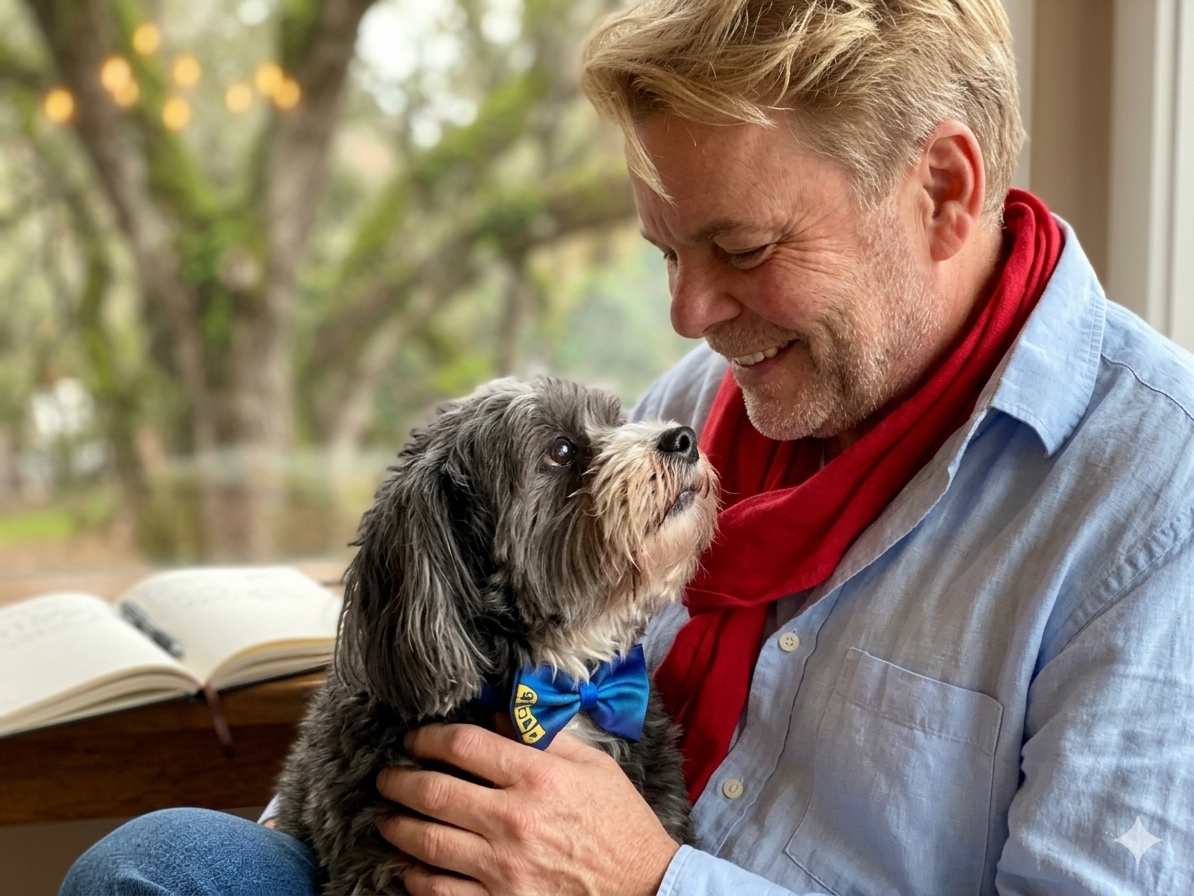
🐾 Story of Roscoe
There is something I have come to understand—
something not taught, but learned through time.
Roscoe does not speak in words.
Not in a language I can write, or translate.
And yet… he communicates.
Through the slightest shift in posture.
Through the quiet tilt of his head.
Through his eyes, his stillness… his presence.
Over the years, I have learned to listen—not with my ears, but with attention.
I know when he is content.
When something is not right.
When he simply needs to stay close.
Every dog is different.
Each carries their own way of speaking.
But if you learn to observe…
if you truly pay attention…
You begin to understand them.
Not in words.
But in something far deeper.
The Duke Who Walks Between Words
Not all companions are given.
Some are forged.
Roscoe did not simply enter my life.
He arrived at the very moment the journey began—when the road was uncertain, the path unmarked, and the story not yet written.
He was small then.
Curious.
Observant.
And from the very beginning, he listened.
🌍 A Companion of Two Worlds
Long before he was given a title, Roscoe was already something rare.
He learned not through instruction, but through presence.
French and English—two languages, two rhythms—woven into daily life. Not taught. Not drilled. But lived.
He began to understand not just words, but tone.
Not just commands, but meaning.
And over time, something remarkable revealed itself:
He did not simply hear language.
He felt it.
🐾 More Than a Companion
There is a common misunderstanding—that the relationship between man and dog is one of ownership.
It is not.
What we built was something else entirely.
Years of:
trust
loyalty
quiet understanding
Tested through:
uncertainty
illness
moments that could have broken lesser bonds
And yet, we remained.
Where I faltered, he steadied.
Where I wandered, he followed—not out of obedience, but out of choice.
👑 The Duke Emerges
Titles are not given lightly.
Roscoe became the Duke not because of ceremony, but because of character.
He carried himself with:
calm authority
quiet presence
unwavering loyalty
And more than that…
He understood.
Not just words.
But emotion.
He knows when I am unwell.
He knows when something is not right.
He senses what cannot be spoken.
And in those moments, he does what few can:
He stays.
✨ The Muse and the Mirror
Every story has a source.
Roscoe is mine.
Not because he inspires imagination—
but because he reflects truth.
He reminds me:
to slow down
to observe
to feel before speaking
Many of the stories told by The Wandering Prince are shaped by this presence.
Not imagined.
Lived.
🌌 A Shared Journey
We have wandered together—through places known and unknown, through chapters both bright and difficult.
From the earliest days to now, something has changed.
Not in distance.
But in understanding.
We are no longer simply two travelling companions.
We are, in a way, one rhythm.
Where I go, he goes.
Where I pause, he waits.
Where I begin again… he is already there.
🪶 The Quiet Truth
The Prince tells the story.
But the Duke ensures it is worth telling.
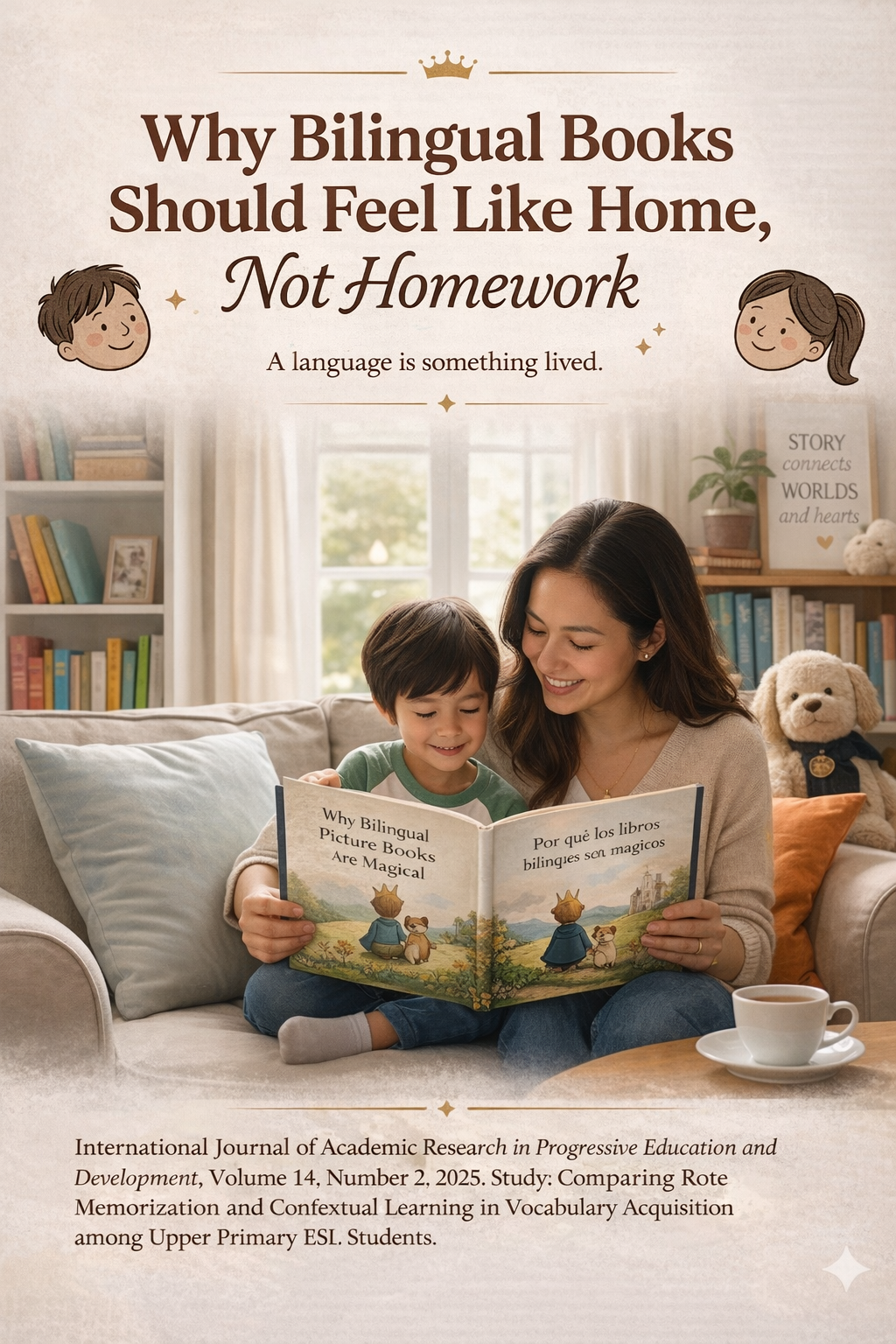
Why Bilingual Books Should Feel Like Home, Not Homework
A language is not something to be captured on a screen—it is something lived. Discover why the oldest method of language learning still outperforms every modern app, and how storytelling brings language back home where it belongs.
A language is not something to be captured on a screen, nor reduced to endless repetition.
It is something lived.
There is a quiet truth many overlook: we do not begin learning language in a classroom. We begin long before that—at home, through sound, rhythm, expression, and meaning.
A child does not memorise their first words.
They absorb them.
Through stories.
Through repetition with purpose.
Through the gentle association of sound and feeling.
This is not rote memorisation.
It is contextual learning—the natural way language is acquired.
It is how we learn our first language.
And it is how additional languages are best understood.
Language, in its truest form, is not studied in isolation. It is experienced—heard in conversation, seen in context, and reinforced through meaningful moments.
This is why bilingual books matter.
They do something few tools can:
they bring language into the rhythm of everyday life.
A story allows a child to:
hear language naturally
see meaning unfold visually
connect words to emotion and experience
And in doing so, something shifts.
The language is no longer foreign.
It becomes familiar.
Research supports this.
Studies on dual language immersion and contextual learning consistently show that children develop stronger language proficiency when learning is embedded in meaningful context, rather than isolated memorisation. Long-term research by Wayne P. Thomas and Virginia P. Collier demonstrates that students in dual language programs often outperform peers in traditional classroom settings, particularly in language development and overall academic achievement.
Similarly, research in second-language acquisition highlights that vocabulary retention improves significantly when words are learned through context, interaction, and repeated meaningful exposure, rather than through rote memorisation alone.
An app can teach you phrases.
It can help you navigate a restaurant or ask for directions.
But it cannot give you a language.
For that, you need the whole picture.
A story, when designed well, recreates that picture beautifully.
It offers repetition with purpose, visual understanding, and emotional connection—allowing a child not simply to recognise a word, but to understand it.
For bilingual families, this approach is not simply beneficial.
It is essential.
Because the goal is not memorisation.
The goal is confidence, comprehension, and connection.
Citations: Thomas, W. P., & Collier, V. P. (2012).
Dual Language Education for a Transformed World.
🧠 Supporting Research
Nation, I. S. P. (2001).
Learning Vocabulary in Another Language.Krashen, S. D. (1982).
Principles and Practice in Second Language Acquisition.
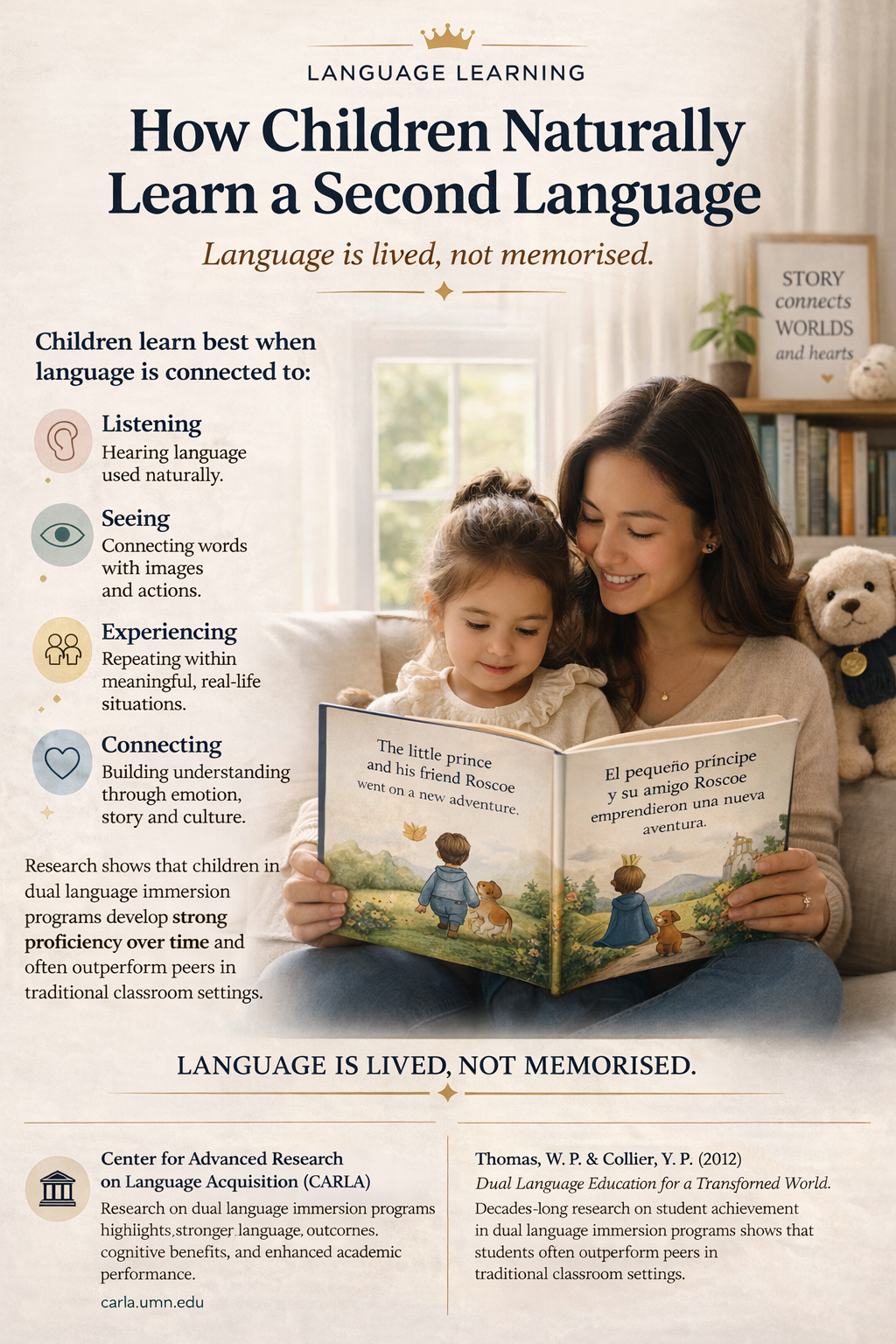
How Children Naturally Learn a Second Language Category: Language Learning
How do children really learn a second language? Discover how immersion, storytelling, and context build real understanding beyond memorisation.
Most language-learning methods focus on one thing: memorisation.
Lists of vocabulary.
Repetition drills.
Structured exercises.
And whilst these may produce short-term recall, they rarely lead to true understanding.
Why?
Because they ignore how the brain actually learns language.
Children do not learn through isolated words.
They learn through context—hearing language used naturally, seeing it paired with images and actions, and repeating it within meaningful situations.
This is not rote memorisation.
It is contextual learning—the most natural and effective form of language acquisition.
It is how we first learn to speak.
And it is how additional languages are best understood.
It is how I learned languages as a child—absorbing words as one absorbs a mother tongue. Not through an app, but through immersion, story, and lived experience.
Research supports this approach.
Long-term studies on dual language immersion programs show that children in these environments develop strong language proficiency over time and often outperform peers in traditional classroom settings. Research from the Center for Advanced Research on Language Acquisition highlights that immersion-based learning supports not only language development, but also cognitive growth and overall academic achievement.
An app can teach you phrases.
It can help you navigate a restaurant or ask for directions.
But it cannot give you a language.
For that, you need the whole picture.
A story, when designed well, recreates this process beautifully.
It offers repetition with purpose, visual cues, and emotional connection—allowing a child not simply to recognise a word, but to understand it.
For bilingual families, this approach is not merely beneficial.
It is essential.
Because the goal is not memorisation.
The goal is confidence, comprehension, and connection.
Sources:
Center for Advanced Research on Language Acquisition (CARLA), University of Minnesota. Research on dual language immersion education and language learning outcomes.
https://carla.umn.edu/immersion/Wayne P. Thomas and Virginia P. Collier (2012).
Dual Language Education for a Transformed World.
Longitudinal research on student achievement in dual language immersion programs.