

Noblesse Nicolas · The Wandering Prince
The Reading Room
Come in. Put down your imaginary satchel. There is a road waiting between these pages, a mystery beneath the lanterns, and a small duke with very particular opinions about lunch.
Choose a story and a language. Open a few pages, linger over an essay, and see where the journey takes you.
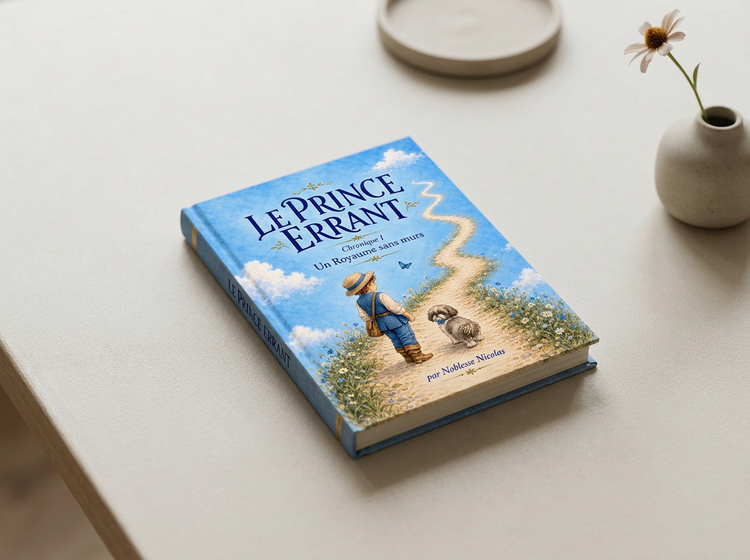
Chronicle One
English · Français
Along the road
A Kingdom Without Walls
Le Prince Errant — Un Royaume sans murs
Perry and Roscoe follow the road into a village where a little kindness has a way of travelling. One empty basket. One new friend. And a kingdom built from the things people do for one another.
English — Open the first pages
Opening excerpt · Chronicle One
The Road
The road began beyond a little wooden gate. No one knew where it ended.
It wandered over green hills, beside quiet rivers and through villages whose names Perry had never heard. Then it disappeared around another bend.
Perry liked that. A road should always keep one surprise for later.
Every morning, he packed his little satchel. Inside was a notebook. A pencil. A handkerchief. And just enough room for something unexpected.
Roscoe carried nothing. He considered that one of Perry’s responsibilities.
That morning, the sun warmed the hills. Tiny drops of dew sparkled on the grass. Somewhere nearby, a skylark sang.
Perry breathed deeply. “What a lovely morning.”
Roscoe stretched. He yawned. Then he stepped carefully around the wet grass.
Perry smiled. “Good morning,” he said to the road. He always greeted the road. It seemed polite.
Roscoe looked at him. Perry greeted rather a lot of things. Trees. Birds. Clouds. Even the occasional interesting stone.
Perry did not mind. He thought most things deserved to be noticed.
A tiny blue butterfly danced across the path. It settled on a wildflower. Perry stopped. “Oh…”
The butterfly opened its wings. Then closed them again.
Perry glanced back at the road. “Did you see it?”
Roscoe looked at the butterfly. It was blue. It had wings. It was, as far as he could tell, definitely a butterfly.
“Chouette,” he said.
A robin watched them from the hedgerow. Its bright little breast shone among the leaves.
Perry smiled. “Good morning.”
The robin tilted its head. Roscoe tilted his.
For one quiet moment, they stared at each other. Then the robin flew to a nearby fence.
Roscoe continued walking. The robin seemed perfectly pleasant. But it was not lunch.
A little farther along, the road reached the top of a hill. Perry stopped.
Below them stood a small stone village. Tall poplar trees lined the road leading into it. Blue shutters framed the windows. Red geraniums spilled from flower boxes.
Beyond an old stone bridge, people were beginning their day. A church bell rang. Once. Then twice.
A breeze climbed the hill. Roscoe lifted his nose. Sniff. Sniff. His ears rose.
Perry laughed. “I know that look.”
Roscoe sniffed again. Something warm drifted from the village bakery. Butter. Flour. A fresh baguette.
Roscoe considered the matter. “Bah…”
“What is it?”
Roscoe looked towards the village. Bread was all very well. For humans. But surely someone down there had remembered the chicken.
Perry followed his gaze. “I wonder who lives there.”
That was always Perry’s first question. Not, What will we find? But, Who will we meet?
The blue butterfly fluttered past them and drifted down the hill. Perry adjusted his satchel. “Shall we?”
Roscoe was already walking.
Français — Ouvrir les premières pages
Extraits du début · Chronique un
La Route
Chaque matin, Perry prépare son petit sac. Il prend son carnet. Son crayon. Son mouchoir. Et il garde toujours un peu de place.
Pour quoi ? Il ne sait pas. C’est pour ça.
Roscoe, lui, ne porte rien. Rien du tout. Pour Roscoe, c’est le travail de Perry.
Ce matin-là, il fait beau. Le soleil brille. L’herbe est encore mouillée. Les oiseaux chantent.
Perry respire un grand coup. « Quelle belle journée ! »
Roscoe s’étire. Puis il regarde l’herbe mouillée. Une patte. Puis l’autre. Non.
Roscoe n’aime pas avoir les pattes mouillées. Perry rit. Puis il regarde la route.
« Bonjour, la Route ! »
Roscoe regarde Perry. Perry dit souvent bonjour aux choses. Aux arbres. Aux oiseaux. Aux nuages. Même aux cailloux.
…
En bas de la colline, il y a un petit village. Des maisons en pierre. Des volets bleus. Des fleurs rouges aux fenêtres. Et là-bas… une boulangerie.
Une bonne odeur monte jusqu’à eux. Du pain chaud. Du beurre. Mmm…
Perry respire. « Ça sent bon ! »
Roscoe respire aussi. Sniff. Sniff. Il réfléchit. Du pain ? Oui. Du beurre ? Oui. Mais…
Roscoe regarde Perry. « Bah… »
Perry sourit. « Quoi ? »
Roscoe regarde encore le village. Il manque quelque chose.
« Du poulet ? » demande Perry.
Roscoe remue la queue. Exactement. Du poulet.
Ils descendent la colline. Puis ils traversent un vieux pont de pierre. Sous le pont, l’eau coule. Des oiseaux passent dans le ciel.
Et bientôt… les voilà sur la place du village.
« Bonjour ! » « Bonjour ! » « Coucou ! »
Tout le monde se salue. Le boulanger prépare son pain. Une dame range des pommes et des poires. Un monsieur arrose ses fleurs. Des enfants jouent.
Perry sourit. Il aime les villages où les gens se disent bonjour.
Roscoe, lui, regarde la boulangerie. Sniff. Sniff. Toujours pas de poulet. « Pfff… »
Perry rit. Puis le petit papillon bleu revient. Il passe devant eux. Il tourne autour de la fontaine. Une fois. Deux fois.
Et Perry voit une petite fille. Elle est assise toute seule. Elle tient un panier. Un panier vide.
Perry s’arrête. Roscoe aussi. Cette fois, Roscoe oublie même le poulet.
Perry regarde la petite fille. Puis il regarde Roscoe.
« Je crois que quelqu’un a besoin d’un ami. »
In loving memory of Roscoe.

A Halloween adventure
English · Español · Ελληνικά
Under the lanterns
The Halloween Heist
The Royal Candy Vault should be full. Dawn is approaching. Somewhere in the lantern-lit streets, a lonely prince is about to find an unlikely friend — and a rather inconvenient mystery.
English — Begin the mystery
Selected opening chapters
A Lonely Prince
Prince Peregrine was not terribly good at being an ordinary prince. While other young royals practised their bows, their waves, and the proper way to sit upon a throne, Peregrine preferred climbing the tallest oak in the courtyard.
From there, he could see beyond the castle walls. And that was where all the interesting things seemed to happen. He explored forgotten staircases, dusty corners and doors that looked as though they ought to lead somewhere extraordinary. But there was one adventure Peregrine had never quite managed to find.
A friend to share them with.
Sometimes he watched the other children laughing and playing below. He wondered what it might be like to have someone waiting for him at the beginning of an adventure.
He did not know it yet, but on this particular Halloween night, Peregrine was about to find more than one.
…
A Most Unusual Meeting
Peregrine wandered through the celebration dressed as a knight. Not a particularly convincing knight.
His armour was made from painted cardboard, his shield was slightly crooked, and every time he walked, something clanked that probably wasn’t supposed to. He rather liked it.
Around him, ghosts giggled beneath white sheets, witches chased one another between the lanterns, and tiny monsters hurried past with pockets full of TRÉTS.
Then something black swooped over Peregrine’s head. Whoosh!
Peregrine ducked.
The little creature circled a lantern, fluttered wildly for a moment and landed upside down beneath a shop awning.
Two enormous ears appeared first. Then two bright eyes.
Peregrine stared. The creature stared back.
“Hello,” said Peregrine.
The creature blinked. “Hello.”
“You’re a bat.”
“I had noticed.”
Peregrine smiled. The bat dropped from the awning, opened his wings and landed neatly on a wooden sign beside him.
“My name is Wisp.”
“Peregrine.”
Wisp tilted his head. “Prince Peregrine?”
Peregrine smiled. “Just Perry will do.”
“Perry,” Wisp repeated. He seemed to approve.
Wisp glanced towards the noisy town square and folded his wings closer around himself. “Too many people,” he muttered.
Perry looked at the crowd. He knew the feeling.
Before either of them could say another word, a terrible cry rang out across the square.
“THE CANDY!”
Everyone stopped. Then came another cry.
“THE CANDY IS ALL GONE!”
Perry and Wisp looked at one another.
For the first time that evening, neither of them felt like standing at the edge of the crowd.
They ran towards the Royal Candy Vault.
The Candy Vault Heist
A crowd had gathered outside the Royal Candy Vault. In the middle of it stood the Royal Baker. He was covered from head to toe in flour, waving both arms as though the kingdom itself were on fire.
“Gone!” he cried. He pointed dramatically towards the enormous open doors. “Every last TRÉT!”
Perry squeezed through the crowd with Wisp fluttering just above his shoulder.
They stopped at the entrance. The Royal Candy Vault was enormous. And completely empty.
No chocolate coins. No caramel apples. No toffees. Not even one of the mysterious purple sweets nobody could identify.
Nothing.
Wisp flew slowly into the vault and looked around. He returned a moment later.
“Well,” he said, “the good news is we won’t need a bigger vault.”
The baker stared at him. Perry tried very hard not to laugh.
“The Great Candy Haul is at dawn!” cried the baker. “What shall we give everyone?”
Wisp glanced into the empty room. “Apparently, disappointment.”
“Wisp,” Perry whispered.
“What? There seems to be plenty of it.”
The Royal Baker groaned. “Halloween is ruined!”
People began whispering. Children clutched their empty TRÉT bags.
Mayor Thistlewick pushed his way through the crowd, his troublesome hat already slipping over one eye.
“Remain calm!” he announced.
Nobody did.
Perry stepped closer to the vault. Something about the empty room bothered him. Someone had taken an entire kingdom’s worth of sweets. That meant whoever had done it had left with an entire kingdom’s worth of sweets.
And that was rather difficult to do without leaving something behind.
Perry crouched beside the doorway. There, between two cobblestones, something shimmered.
A tiny speck of purple glitter. Then another. And another.
They formed a faint sparkling trail leading away from the vault.
Perry looked at Wisp. Wisp looked at the glitter.
“Well,” said Wisp, spreading his wings. “That seems suspiciously convenient.”
Perry grinned. “Shall we?”
Wisp sighed. “I’ve known you for approximately five minutes.”
He flew towards the glittering trail. “Obviously.”
Español — Entrar en el misterio
Primeras páginas · Edición revisada
El príncipe solitario
Peregrine no era un príncipe común. Los otros príncipes practicaban saludos. Peregrine trepaba a los árboles.
Desde la rama más alta veía el mundo fuera del castillo. Allí ocurrían las cosas interesantes.
Peregrine encontraba escaleras secretas. Encontraba puertas antiguas. Encontraba rincones llenos de polvo.
Pero había algo que no podía encontrar.
Un amigo.
Aquella noche era Halloween. Y antes de salir el sol, Peregrine encontraría dos.
…
Un encuentro muy extraño
Peregrine llevaba una armadura de cartón. Clanc, clanc, clanc.
No parecía un caballero perfecto. Pero a él le gustaba.
De pronto, algo negro pasó sobre su cabeza.
¡Fiuuu!
Peregrine se agachó. Un pequeño murciélago quedó colgado bajo un toldo.
Peregrine lo miró. El murciélago lo miró.
—Hola —dijo Peregrine.
—Hola.
—Eres un murciélago.
—Ya me había dado cuenta.
Ελληνικά — Η αρχή του μυστηρίου
Απόσπασμα από την αρχή
Ένας μοναχικός πρίγκιπας
Ο πρίγκιπας Πέρι δεν ήταν ιδιαίτερα καλός στο να είναι ένας συνηθισμένος πρίγκιπας.
Ενώ οι άλλοι νεαροί γαλαζοαίματοι εξασκούνταν στις υποκλίσεις, στους χαιρετισμούς και στον σωστό τρόπο να κάθονται σε έναν θρόνο, ο Πέρι προτιμούσε να σκαρφαλώνει στην ψηλότερη βελανιδιά της αυλής.
Από εκεί έβλεπε πέρα από τα τείχη του κάστρου. Εκεί έξω φαίνονταν να συμβαίνουν όλα τα ενδιαφέροντα πράγματα.
Εξερευνούσε ξεχασμένες σκάλες, σκονισμένες γωνιές και πόρτες που έμοιαζαν πως έπρεπε να οδηγούν κάπου θαυμαστό. Όμως υπήρχε μία περιπέτεια που δεν είχε καταφέρει να βρει.
Έναν φίλο για να τη μοιραστεί.
Μερικές φορές παρακολουθούσε τα άλλα παιδιά να γελούν και να παίζουν. Αναρωτιόταν πώς θα ήταν να τον περίμενε κάποιος στην αρχή μιας περιπέτειας.
Δεν το ήξερε ακόμη, αλλά εκείνη τη νύχτα του Χάλογουιν θα έβρισκε περισσότερους από έναν.
…
Μια πολύ ασυνήθιστη συνάντηση
Ο Πέρι περπατούσε ανάμεσα στα φαναράκια ντυμένος ιππότης.
Όχι ιδιαίτερα πειστικός ιππότης.
Η πανοπλία του ήταν από βαμμένο χαρτόκουτο, η ασπίδα του ήταν λίγο στραβή και, κάθε φορά που περπατούσε, κάτι κουδούνιζε ενώ μάλλον δεν έπρεπε.
Του άρεσε πολύ.
Ξαφνικά κάτι μαύρο πέρασε πάνω από το κεφάλι του.
Φουουους!
Το μικρό πλάσμα έκανε έναν κύκλο γύρω από ένα φανάρι και κρεμάστηκε ανάποδα κάτω από μία τέντα. Πρώτα φάνηκαν δύο τεράστια αυτιά. Μετά δύο λαμπερά μάτια.
«Γεια σου», είπε ο Πέρι.
«Γεια.»
«Είσαι νυχτερίδα.»
«Το πρόσεξα κι εγώ. Ευτυχώς λύθηκε γρήγορα το πρώτο μας μυστήριο.»
Ο Πέρι χαμογέλασε.
«Με λένε Γουίσπ.»
«Πέρι.»
«Ο πρίγκιπας Πέρι;»
«Μόνο Πέρι.»
Ο Γουίσπ κοίταξε την πολυκοσμία και τύλιξε τα φτερά γύρω του.
«Πάρα πολλοί άνθρωποι. Και όλοι έχουν άποψη. Εξαιρετικά κουραστικό.»
Ο Πέρι ήξερε ακριβώς τι εννοούσε.
Τότε μια τρομερή κραυγή ακούστηκε από την πλατεία.
«ΤΑ ΓΛΥΚΑ!»
Και αμέσως μετά:
«ΤΑ ΓΛΥΚΑ ΕΞΑΦΑΝΙΣΤΗΚΑΝ!»
Ο Πέρι και ο Γουίσπ κοιτάχτηκαν.
«Πέντε λεπτά σε γνωρίζω», είπε ο Γουίσπ, «και ήδη έχουμε ληστεία. Θαυμάσια αρχή.»
Έτρεξαν προς το Θησαυροφυλάκιο.
Η κλοπή στο Θησαυροφυλάκιο
Ο Βασιλικός Ζαχαροπλάστης στεκόταν μπροστά στις ορθάνοιχτες πόρτες, γεμάτος αλεύρι και κουνώντας τα χέρια σαν να είχε πάρει φωτιά ολόκληρο το βασίλειο.
«Χάθηκαν! Όλα!»
Το Θησαυροφυλάκιο ήταν τεράστιο. Και εντελώς άδειο.
Ο Γουίσπ πέταξε μέσα, κοίταξε γύρω και επέστρεψε.
«Τα καλά νέα είναι ότι δεν θα χρειαστούμε μεγαλύτερο Θησαυροφυλάκιο.»
Ο ζαχαροπλάστης τον κοίταξε άφωνος.
«Τι θα δώσουμε σε όλους το πρωί;»
Ο Γουίσπ ξανακοίταξε το άδειο δωμάτιο.
«Απογοήτευση. Έχουμε άφθονη.»
«Γουίσπ», ψιθύρισε ο Πέρι.
«Τι; Προσπαθώ να βοηθήσω με την απογραφή.»
Ο Πέρι γονάτισε κοντά στην πόρτα. Αν κάποιος είχε πάρει τα γλυκά ενός ολόκληρου βασιλείου, κάτι θα είχε αφήσει πίσω του.
Ανάμεσα σε δύο πέτρες έλαμψε ένας κόκκος μοβ σκόνης. Μετά άλλος ένας. Κι άλλος.
Ένα αχνό μοβ μονοπάτι απομακρυνόταν από το Θησαυροφυλάκιο.
«Υπερβολικά βολικό», είπε ο Γουίσπ. «Άρα εξαιρετικά ύποπτο.»
«Πάμε;»
Ο Γουίσπ αναστέναξε θεατρικά.
«Φυσικά. Γιατί να αφήσουμε μια κακή ιδέα να περιμένει;»
Η περιπέτεια συνεχίζεται στο Η κλοπή των γλυκών του Χάλογουιν.
Συνεχίστε την περιπέτεια →Essays & Midnight Musings · A Halloween anthology
Tales from the 3 A.M. Resurrection
One unreasonable morning. Four coffees. One dog. Deeply caramelised pancakes, disappearing euros, and a city operating on entirely the wrong schedule.
Personal essays for adult readers · Contains strong language.
In loving memory of Roscoe.
Read the complete original essays below. The Creature Awakens, featuring Roscoe, is the interlude within The 3 A.M. Resurrection. The Pancakes of Doom leads into The Human Operating Manual.
Tales I–II · The Resurrection & The Creature Awakens — Read the full essay
Tales I–II · The Resurrection & The Creature Awakens
The 3 A.M. Resurrection
I woke up at three o'clock this morning.
Why?
Fuck knows.
I opened my eyes and immediately had absolutely no idea what was happening.
You know that strange moment when you wake in the middle of the night and your brain hasn't quite arrived yet? You're technically conscious, but that's about the only qualification you possess for being considered alive.
That was me.
I didn't know what day it was. I didn't know why I was awake. I wasn't even particularly interested in finding out.
I just stared into the darkness thinking, What the fuck am I doing awake?
And then, for reasons I still cannot explain, I got up.
Now this was a mistake.
Because I wasn't awake.
I had been resurrected.
There is a difference.
I was a newly created zombie.
Not one of those experienced zombies you see wandering confidently through films who clearly know what their objectives are. They have direction. They have purpose. They know whom they're chasing.
I was a newborn zombie.
No training.
No instructions.
No fucking clue.
So there I was, wandering through the house at three-something in the morning, wobbling about, running into things and swearing at furniture.
I swear the furniture moves at night.
There's no other explanation for it.
Eventually I found the kitchen.
Coffee.
Yes.
Coffee.
That seemed to be the first intelligent thought my brain had produced.
So I made a pot of coffee.
I drank some.
And I didn't like it.
Now, under normal circumstances, a reasonable person might think: Well, Nicolas, perhaps coffee isn't the problem.
But reasonable Nicolas was still dead upstairs somewhere.
Zombie Nicolas decided the obvious solution was to make another coffee.
So out came the Nespresso. The one with the enormous capsules. Vertuo, Velour, whatever the bloody thing is called at three in the morning. At that hour it could have been called Princess Anastasia's Magical Coffee Contraption and I would have accepted it.
Coffee number two.
Much better.
I sat there drinking it, waiting for some recognisable version of myself to appear.
Nothing.
Then I heard movement.
Oh, no.
Roscoe.
Now apparently my wandering around the house had alerted His Lordship to the possibility that morning had begun.
It had not.
It was four o'clock in the fucking morning.
Roscoe disagreed.
He wanted breakfast.
Of course he wanted breakfast.
So I fed him.
Surely that would settle matters.
No.
Now he wanted to go out.
I looked at him.
He looked at me.
For Christ's sake, dog.
He continued looking at me.
Fine.
Out we went.
And there I was, wandering through the streets before dawn looking exactly how I felt: half dead, slightly wobbly and completely bewildered as to why I was participating in life at this hour.
Meanwhile Roscoe was having an absolutely marvellous time.
He didn't give a rat's arse about me.
Not one.
He had things to do.
There was a wall over there that apparently contained extremely important information.
Sniff.
A tree.
Sniff.
A doorway.
Sniff.
Something on the pavement requiring a full forensic investigation.
Roscoe. Come on.
Sniff.
Roscoe.
Nothing.
For Christ's sake, Roscoe.
More sniffing.
He was trotting along happily, exploring his little world, while I staggered behind him wondering whether it was possible to fall asleep whilst standing upright.
And I started getting cross.
I was tired.
I was miserable.
I hadn't asked to be awake.
I certainly hadn't asked to be walking through the streets at four o'clock in the morning while a sixteen-year-old Shih Tzu conducted a neighbourhood census through his nose.
Then I looked at him.
Really looked at him.
He was just... happy.
That's all.
He didn't know it was four in the morning.
He didn't know I'd slept badly.
He didn't know I was cross.
He didn't know that respectable civilisation had another two or three hours before opening.
He knew he had eaten breakfast.
He was outside.
He could smell things.
He was with me.
And he was having a lovely little walk.
Suddenly I felt rather awful for being cross with him.
So I let him have his moment.
Eventually I picked him up and carried him home.
By five o'clock I was starving.
And for some inexplicable reason I thought:
Pancakes.
Why pancakes?
Again: newly resurrected zombie. Don't look for logic.
So I made the batter, heated the griddle, poured the pancakes and then...
sat down.
I completely forgot about them.
Completely.
I'm sitting there in my chair doing God knows what when suddenly I smell something.
What's that?
Pause.
What the fuck is burning?
Then it hit me.
THE PANCAKES.
I hurried into the kitchen with whatever degree of urgency a newly resurrected zombie can reasonably muster.
The pancakes were...
Well.
Let's call them deeply caramelised.
Very deeply caramelised.
The sort of deep, dark, rustic finish one might deliberately describe that way on a restaurant menu because I forgot the bloody pancakes were on the griddle lacks culinary romance.
They were not charcoal.
They were edible.
And, actually, they were still rather delicious.
So yes.
I ate the bloody things anyway.
I was starving.
There comes a point in life when aesthetic standards become an unaffordable luxury.
Five o'clock in the morning after an unscheduled resurrection, multiple coffees and a pre-dawn constitutional with Roscoe is one of those points.
Then came another coffee.
And another.
By this stage, I had stopped counting properly, which seems reasonable considering I had also temporarily forgotten the existence of pancakes.
But for the historical record, we are now at coffee number four.
Golden caramel.
And somewhere around this point, something happened.
Not a transformation.
Let's not get carried away.
The fog did not lift.
The clouds did not part.
No choir began singing.
I was still dead.
I simply wasn't walking around dead anymore.
There is progress, and one must take it where one finds it.
And then dawn approacheth.
Bloody marvellous.
There it was, creeping into the morning as though this were all perfectly normal.
Oh, look. Another glorious morning.
And I'm bloody awake.
This is apparently the moment when I'm supposed to throw open the curtains, inhale deeply and greet the newborn day while birds chirp outside the window and woodland creatures gather lovingly around my feet.
Perhaps a rabbit appears.
Perhaps a bluebird lands upon my shoulder.
Perhaps I begin singing.
No.
I'm sitting in a chair on my fourth coffee wondering how the hell it is morning already.
But something else had begun happening.
Ideas.
One appeared.
Then another.
The cookbook.
Halloween recipes.
The musical.
Stories.
Things I wanted to change.
Things I wanted to make.
Something funny I'd thought of.
Another idea.
Then another bloody idea.
My brain, apparently having refused to perform basic functions such as remembering pancakes, had nevertheless decided it was perfectly capable of creative development.
So I started talking.
Thinking.
Creating.
Writing.
Not quite Nicolas again.
Let's not exaggerate.
But slowly materialising.
A hand here.
A functioning sentence there.
Occasional evidence of higher thought.
Four coffees apparently assisting with reconstruction.
And then, around six or half past six, I noticed something.
Silence.
Where was Roscoe?
I looked over.
The little bastard had gone back to sleep.
Of course he had.
His morning was finished.
He had awakened, demanded breakfast, taken me outside at four in the morning, inspected half the neighbourhood and returned home completely satisfied with himself.
And now he was sleeping peacefully.
Meanwhile, I'm sitting in my chair with enough caffeine circulating through my body to power a small Mediterranean nation, deeply caramelised pancakes somewhere in my digestive system, ideas flying through my head, and absolutely no possibility whatsoever of returning to bed.
And I started laughing.
Because what else can one do?
The morning had been a complete bloody disaster.
Except...
it hadn't.
That's the strange part.
At three o'clock, I would have happily cancelled the entire thing.
At four, I was wandering through the streets swearing under my breath.
At five, I was rescuing pancakes I'd forgotten existed.
And somewhere amongst the coffee, Roscoe, the swearing, the wandering, the pancakes and the approaching dawn, the whole ridiculous morning became something else.
Not better, necessarily.
Let's not become inspirational about this.
I'm still bloody tired.
But it became mine.
And it became a story.
We spend so much time deciding what a good day is supposed to look like.
Wake at the proper time.
Have the proper breakfast.
Drink the proper coffee.
Do things in the proper order.
Be productive.
Be organised.
Be fucking marvellous.
And sometimes life says, No.
Sometimes you wake at three in the morning with no idea who you are.
Sometimes the dog wants breakfast at four.
Sometimes you nearly incinerate the pancakes.
Sometimes you walk into furniture.
Sometimes you've used half the English language's available swear words before sunrise.
And sometimes, somehow, it becomes a story.
So here I am.
It is now half past seven.
Four and a half hours after my resurrection.
Roscoe is asleep.
Naturally.
I'm sitting in my chair, exhausted, caffeinated and marginally more coherent than the creature who first stumbled out of bed.
The fog hasn't lifted.
I haven't transformed.
I'm simply... materialising.
And perhaps that's enough.
Because somewhere amongst all this ridiculousness, I realised I should write about it.
So I did.
At three o'clock this morning, I woke up as the newly undead.
Four and a half hours, four coffees, one dog walk and several deeply caramelised pancakes later...
I have a blog.
Bloody hell.
Turn Life Into Story.
Tale III · The Pancakes of Doom / The Human Operating Manual — Read the full essay
Tale III · The Pancakes of Doom / The Human Operating Manual
Why Didn't Humans Come With an Operating Manual?
It occurred to me this morning, somewhere between becoming a zombie and nearly sacrificing a batch of pancakes to the gods of the griddle, that human beings really ought to come with instructions.
Everything else does.
Buy a coffee machine and you receive a booklet.
Buy a toaster and somewhere amongst the paperwork will be a warning explaining that inserting inappropriate objects into it may result in consequences.
Appliances have operating instructions.
They have maintenance schedules.
They have troubleshooting guides.
They have warranties.
They even have little caution symbols showing a tiny illustrated person doing something catastrophically stupid.
But humans?
Nothing.
We simply arrive.
No handbook.
No troubleshooting section.
No manufacturer's warranty.
Nobody hands you a card saying:
Congratulations on becoming a human being. Before operation, please read the following instructions carefully.
Which seems remarkably irresponsible.
Had such a manual existed, I might have consulted it at four o'clock this morning and discovered:
WARNING: Do not operate heated appliances whilst experiencing Zombie Mode.
Zombie Mode may occur following insufficient sleep or unexpected resurrection during prohibited hours.
Symptoms include:
Confusion.
Poor coordination.
Walking into furniture.
Inability to determine what day it is.
Excessive use of colourful vocabulary.
Making pancakes and subsequently forgetting that pancakes exist.
If Zombie Mode occurs, discontinue operation of all potentially hazardous equipment until basic human functionality has returned.
That would have been useful.
There should probably be other warnings.
CAUTION: Do not make important decisions whilst hungry.
WARNING: The phrase "I'll remember that" does not constitute an approved memory-storage system.
CAUTION: Opening the refrigerator repeatedly will not cause new food to appear.
WARNING: Sitting down "for five minutes" may result in the unexplained disappearance of several hours.
And, particularly relevant in my household:
CAUTION: DOG ACTIVATION
Movement detected before sunrise may activate nearby dog.
Once activated, dog may request breakfast, outdoor access and extensive neighbourhood investigation.
Deactivation cannot be guaranteed.
Why don't we have these?
Perhaps because we spend our lives learning the operating instructions as we go.
Usually immediately after doing the thing the manual would have warned us not to do.
Which seems an unnecessarily expensive method of product testing.
So I have decided that humanity needs a handbook.
Nothing terribly philosophical.
Just the essentials.
THE HUMAN OPERATING MANUAL
Do's, Don'ts, Warnings & Other Information That Really Should Have Come in the Box.
Rule Number One:
Do not make pancakes at four o'clock in the morning when you have only recently been resurrected.
I tested this one personally.
You're welcome.
Turn Life Into Story.
Tale IV · The Disappearing Euros — Read the full essay
Tale IV · The Disappearing Euros
The Case of the Disappearing Euros
I was about to go to the little market express this morning because I needed something.
Nothing terribly exciting.
Just one of those perfectly ordinary things one suddenly realises one needs, which requires putting on shoes, finding one's wallet and venturing out into civilisation.
So I went to my billfold.
Opened it.
And stopped.
There was money in there.
Just considerably less money than I remembered.
Now, I distinctly recall going to the bank on Thursday.
Today is Sunday.
I think.
After this morning's three o'clock resurrection, I'm not prepared to make categorical statements about what day it is, but I have been reliably informed that it is Sunday.
On Thursday, I withdrew €500.
Five hundred euros.
Ten crisp €50 notes.
Very satisfying.
Very organised.
Very tangible.
And now?
€160.
I stared at it.
Then counted it again.
As though perhaps the other €340 might emerge from behind one of the notes and say, Surprise!
Nothing.
€160.
Where the hell did the rest of it go?
This is where the investigation began.
I sat down and started reconstructing the last three days.
Had I gone shopping?
No.
Had I indulged in some wild bout of retail therapy and forgotten about it?
No.
There was no fabulous new coat hanging mysteriously in the wardrobe.
No extravagant purchase sitting on a table.
No parcel arriving that might explain everything.
Nothing.
So where did €340 go?
I started retracing my movements.
Coffee.
Yes.
I buy coffee when I walk Roscoe during the day.
That's normal.
Sometimes another coffee.
Also entirely possible.
A few miscellaneous things here and there.
The grocery store.
Yes, I'd gone a few times, but not for a proper shop. Just the usual little things one picks up because one needs them.
Milk.
Something for dinner.
Something I'd forgotten.
Something I hadn't realised I needed until I saw it.
The usual domestic suspects.
Then there is Roscoe.
Roscoe is expensive.
He is sixteen years old, has particular requirements and apparently operates under the financial philosophy that retirement should be enjoyed in considerable comfort.
So yes, I bought things for Roscoe.
More than once.
Possibly two or three times.
I began adding together everything I could remember.
Coffee.
Groceries.
Roscoe.
Miscellaneous bits.
Another coffee.
Probably Roscoe again.
And yet I still couldn't account for it properly.
That's the peculiar thing about cash.
When you use a card, your money leaves footprints.
There it is.
€8.40 here.
€17.60 there.
€32.10 somewhere else.
Every little financial indiscretion neatly documented for future interrogation.
Cash leaves nothing.
Cash simply...
vanishes.
You hand over a €50 note.
Someone gives you change.
The change goes into the billfold.
Then some of it becomes another coffee.
Some becomes groceries.
Some becomes dog food.
Some becomes something you needed but can no longer remember needing.
The coins multiply mysteriously while the notes disappear.
And three days later you open your wallet and discover that €340 has apparently evaporated into the atmosphere.
There is no crime scene.
No witnesses.
No paper trail.
Just a suspicious packet of coins.
I looked at those coins.
They knew something.
I could feel it.
But they weren't talking.
And this is where I began to suspect something supernatural.
Perhaps the house isn't haunted by ghosts.
Perhaps it's haunted by euros.
Maybe while I'm asleep, little €50 notes climb out of my billfold and escape beneath the front door.
Perhaps they're out there somewhere now.
Living their best lives.
One is having coffee.
One has gone to Mykonos.
Another is probably supporting Roscoe.
Actually, several are probably supporting Roscoe.
And now, after conducting this exhaustive financial investigation and solving absolutely nothing, I am preparing to go to the market.
To spend more money.
Of course I am.
Because I still need the thing I originally went to my wallet to buy before discovering that I had inadvertently opened a missing-persons investigation.
And perhaps that's the real mystery of everyday money.
It doesn't usually disappear in great dramatic acts of extravagance.
Sometimes it disappears quietly.
A coffee.
A few groceries.
Something for the dog.
Something you needed.
Something else you needed.
Another coffee.
€50 becomes €37.
€37 becomes €22.
€22 becomes a collection of coins that weighs approximately four kilograms but somehow possesses a purchasing power of twelve euros.
And then one Sunday morning you stand there staring into your billfold thinking:
Where did all my bloody money go?
I still don't know.
I have theories.
Roscoe remains a person of interest.
But I have insufficient evidence to bring charges.
So I'm off to the market.
With considerably less money than I thought I had.
If another €50 disappears before I get home, I'm calling an exorcist.
Turn Life Into Story.
Tale V · The City That Wouldn’t Wake — Read the full essay
Tale V · The City That Wouldn’t Wake
Apparently, Eight O'Clock Is Too Early Now
Don't you just hate, hate, hate when you finally drag yourself out of the house to buy the one thing you need, only to discover that apparently the rest of civilisation has decided not to participate?
It is eight o'clock on Sunday morning.
Eight.
Not five.
Not six.
Eight.
And nothing is bloody open.
Or they're just opening, which is somehow even more irritating because you can see civilisation preparing itself while you're standing there waiting for civilisation to hurry the hell up.
I remember when you could go outside at six or seven in the morning and find something open.
A little market.
A kiosk.
Something.
Somewhere.
Now?
Nothing.
And perhaps I wouldn't find this quite so peculiar had I not accidentally conducted some anthropological fieldwork at three o'clock this morning.
Because at three o'clock?
Apparently everybody is awake.
Cars everywhere.
People everywhere.
Music coming from somewhere in the distance.
A bar? A club? A discotheque?
I didn't even know we still had those around here.
There I was, newly resurrected and wandering through the darkness with Roscoe, thinking:
Why the hell is everybody awake?
Five hours later, I'm standing outside trying to buy something, thinking:
Why the hell is nobody awake?
Apparently I have discovered the precise period during which the city changes shifts.
The night people haven't quite gone home.
The morning people haven't quite arrived.
And I, through spectacularly poor planning, have managed to become inconvenienced by both.
Because yes, this is partly my own fault.
I could have bought what I needed yesterday.
I forgot.
Or I was tired.
Or I simply couldn't be bothered.
One of those perfectly reasonable decisions that becomes considerably less reasonable the following morning when you're standing outside a closed shop muttering at a metal shutter.
So perhaps nothing has gone wrong with the city.
Perhaps I've simply wandered into the wrong chapter of its day.
At three in the morning, I wanted everyone to go to bed.
At eight in the morning, I want everyone to get up.
Apparently the only person whose schedule I approve of today is mine.
And even I don't approve of mine.
Turn Life Into Story.
Finale · The Zombie’s Creative Revenge — Read the full essay
Finale · The Zombie’s Creative Revenge
Apparently, Even Zombies Can Be Creative
I've discovered something this morning.
Apparently, even zombies can be creative.
This is not something I knew.
I've had mornings like this before.
I wake far too early, stumble around the house half conscious, make coffee, walk into furniture, say things that ought not to be repeated in polite society and generally wait for my brain to join the rest of my body.
Normally, that's where it ends.
Eventually I become human again and get on with the day.
But this morning I did something different.
I started talking to the computer.
And suddenly all the ridiculous little thoughts that normally pass through my head during Zombie Mode had somewhere to go.
That's when things became interesting.
One thought became The 3 A.M. Resurrection.
Then I opened my wallet and couldn't work out where several hundred euros had gone.
That became The Case of the Disappearing Euros.
Then I went outside at eight o'clock and became irritated because nothing was open, despite having been equally irritated at three o'clock because everybody seemed to be awake.
Which produced:
At three in the morning, I couldn't understand why everyone was still awake.
At eight in the morning, I couldn't understand why everyone wasn't awake.
Then I remembered the pancakes.
The pancakes I had put on the griddle at some ungodly hour and nearly forgotten about.
That led to another thought:
Why do appliances come with instruction manuals, safety warnings and troubleshooting guides, but humans don't?
Surely there ought to be a label somewhere saying:
CAUTION: DO NOT OPERATE HEATED APPLIANCES WHILST IN ZOMBIE MODE.
And suddenly I had The Human Operating Manual.
All before breakfast.
Well, technically there was breakfast.
Deeply caramelised breakfast.
And that's when something occurred to me.
Maybe creativity doesn't always require us to be at our best.
We tend to treat creativity as something requiring the proper conditions.
Be rested.
Be focused.
Clear the desk.
Make the coffee.
Find the right music.
Open the notebook.
Create.
But perhaps some ideas arrive precisely because the normal filters aren't fully operational yet.
Zombie Brain doesn't necessarily behave itself.
It wanders.
It connects things that don't belong together.
Pancakes become safety warnings.
A missing €50 note becomes a fugitive.
A closed shop becomes an argument with civilisation.
A dog sniffing a wall at four o'clock in the morning becomes an observation about happiness.
None of those thoughts began with:
I should write something clever.
They began with:
That's bloody ridiculous.
And perhaps that's important.
Because I think we lose a tremendous number of ideas by judging them before we've caught them.
That's stupid.
That's nothing.
Nobody would care about that.
I'll remember it later.
I'll write it down when I'm properly awake.
And then later arrives.
The brain becomes sensible.
The day fills up.
The peculiar little thought that appeared at 4:17 in the morning disappears.
Gone.
This morning, for whatever reason, I caught them.
Not polished them.
Not perfected them.
Just caught them.
There's a difference.
I wouldn't necessarily trust Zombie Nicolas to make important decisions.
I have seen what he does with pancakes.
But perhaps I should trust him with ideas.
Maybe creativity doesn't always need consciousness at full operating capacity.
Maybe sometimes the sensible brain gets in the way.
The sensible brain asks whether an idea is useful.
Whether it fits the brand.
Whether people will read it.
Whether it's worth developing.
Whether there's enough material.
Zombie Brain apparently says:
Where the hell did my €340 go?
And suddenly there's a story.
So perhaps I need to add another section to The Human Operating Manual:
ZOMBIE MODE: CREATIVE APPLICATIONS
When operating at reduced cognitive capacity, do not drive heavy machinery, make important financial decisions or attempt complicated culinary procedures.
However:
Keep a notebook nearby.
Record strange observations.
Capture ridiculous thoughts.
Do not evaluate.
Do not edit.
Do not attempt to determine whether the idea is any good.
That function may be performed later by a fully operational human.
Because apparently even when you think your brain isn't working...
it may simply be working differently.
And occasionally, amongst the fog, the coffee, the irritation and the deeply caramelised pancakes, it hands you something rather wonderful.
Catch it before it disappears.
You can become human later.
Turn Life Into Story.
A little longer by the window
The essay shelf
Stories about the life behind the stories — friendship, language, and the small things that make a world feel like home.
Children Remember Stories Before They Remember Lessons — Read the full essay
Children Remember Stories Before They Remember Lessons
There is a peculiar mistake we adults sometimes make when creating things for children.
We become so concerned with what they ought to learn that we forget to give them something worth remembering.
A child rarely closes a beloved book and says, “That was an excellent educational experience.”
They remember the moonlit forest.
The peculiar little creature hiding behind the tree.
The grandmother who knew precisely what to say.
The dog who was far more interested in chicken than in whatever grand adventure everyone else was discussing.
They remember how the story made the room feel.
And somewhere inside all of that, almost unnoticed, the lesson remains.
I have come to believe that this is particularly important when we introduce children to another language.
Language learning is often presented as acquisition: vocabulary, grammar, repetition, achievement.
But language existed long before worksheets did.
Language lived around kitchen tables.
It travelled through songs, family sayings, jokes, recipes, letters, bedtime stories and the curious expressions grandparents used that nobody quite knew how to translate.
It belonged to life.
That is why I approach bilingual storytelling not as a lesson disguised as a book, but as a story that happens to open another door.
The child should want to know what happens next before wondering whether a word is French, Spanish, Greek or English.
Curiosity must arrive before instruction.
Once a character becomes familiar, another language no longer feels entirely foreign.
The child already knows the world.
They recognise the village, the friend, the problem, the joke.
Only some of the words have changed.
And perhaps that is one of storytelling’s quietest gifts.
It allows the unfamiliar to enter through a familiar door.
This matters beyond language learning.
Stories are one of the ways families preserve culture without placing it behind glass.
Heritage should not feel like an exhibit children are instructed to admire from a respectful distance.
It should be something they can wander through.
A scent.
A phrase.
A celebration.
A family eccentricity.
A recipe with a story attached to it.
A character who reminds them of somebody they know.
When culture becomes lived experience rather than curriculum, children begin to make it their own.
That is ultimately what I want from the stories I create.
Not children memorising lessons.
Children remembering worlds.
Because a lesson may tell us what something means.
A story gives us a reason to care.
And we tend to keep the things we care about.
Turn Life Into Story.
Heritage Is Not Something We Keep in a Museum — Read the full essay
Heritage Is Not Something We Keep in a Museum
Heritage is often spoken about as though it belongs entirely to the past.
Old photographs.
Recipes written in fading ink.
Family names.
Traditional songs.
Objects carefully wrapped and stored because somebody once told us they were important.
All of those things matter.
But heritage cannot survive on preservation alone.
It must also be used.
Spoken.
Cooked.
Retold.
Questioned.
Adapted.
Passed across the table.
Otherwise, sooner or later, it becomes a museum exhibit.
Beautiful perhaps, but silent.
This becomes especially important for families who live far from the places their stories began.
Migration changes the geography of a family remarkably quickly.
A grandmother may have grown up in one country.
Her children may build lives in another.
The grandchildren may speak a different first language entirely.
Within only a few generations, something once completely ordinary can begin to feel remote.
A saying disappears.
A recipe becomes simplified.
A family story loses three details every time it is retold.
One day somebody asks, “Where did that tradition come from?”
And nobody quite remembers.
I find that both fascinating and rather sad.
But it is not inevitable.
Stories give families a surprisingly powerful way to carry culture forward without freezing it in time.
A story can preserve the flavour of a place while still belonging to a child growing up thousands of miles away.
A bilingual book can allow two languages to sit together rather than compete.
A recipe can become an invitation to tell someone where it came from.
A character can carry fragments of family memory into an entirely new adventure.
This is why I increasingly think of heritage not as inheritance, but as conversation.
Inheritance suggests something handed over intact.
Conversation changes slightly with every participant.
And perhaps that is exactly what culture has always done.
Each generation receives something.
Each generation adds something.
Then it passes it along.
The danger is not that culture changes.
Culture has always changed.
The danger is that the conversation stops.
For writers, parents, grandparents, teachers and creators, there is therefore a wonderfully simple question worth asking:
What story do we know that the next generation does not?
It need not be grand.
Perhaps it is the reason a certain dish appears every Christmas.
Perhaps it is the phrase your grandmother always used.
Perhaps it is the story of somebody leaving one country and beginning again in another.
Perhaps it is simply the tale everyone in the family has heard so often that nobody thought to write it down.
Those are often the stories most worth keeping.
Because heritage is not merely what came before us.
It is what we choose to carry forward.
And stories remain one of the finest travelling cases ever invented.
Turn Life Into Story.
The Story of Roscoe
A little dog, an unexpected meeting, and the companion at the heart of the Wandering Prince’s world.
Read the essay →Home, Not Homework
Why bilingual books should feel like an invitation into a story.
Read the essay →A Language Through Stories
How children naturally find their way into a second language.
Read the essay →A springtime visit
The Great Easter Promise
A seasonal story to return to when the road turns towards spring.
Discover the story →Step inside the mystery
The Great Halloween Mystery
When you are ready to leave the reading chair, the Halloween world is waiting.
Enter the mystery →Story excerpts © Noblesse Nicolas. The Wandering Prince · Turn Life Into Story.